Do organisations need more AI training? More workshops on tools, more programmes on automating workflow?
Both sound reasonable. Neither addresses the gap that is actually costing money.
Across the organisations I have worked with, few show sophisticated understanding of what AI tools can do at a functional level. Most have learned the surface layer — the feature that helps with today's task. That is useful. It was never the hard part.
The harder problem is connecting AI to business operations: redesigning the SOPs underneath it, and preparing the people who will have to work differently as a result. That work does not begin with a tool. It begins with a decision about what the AI is for.
The market gap is not AI awareness. It is the absence of a structured way to decide what AI should be used for.
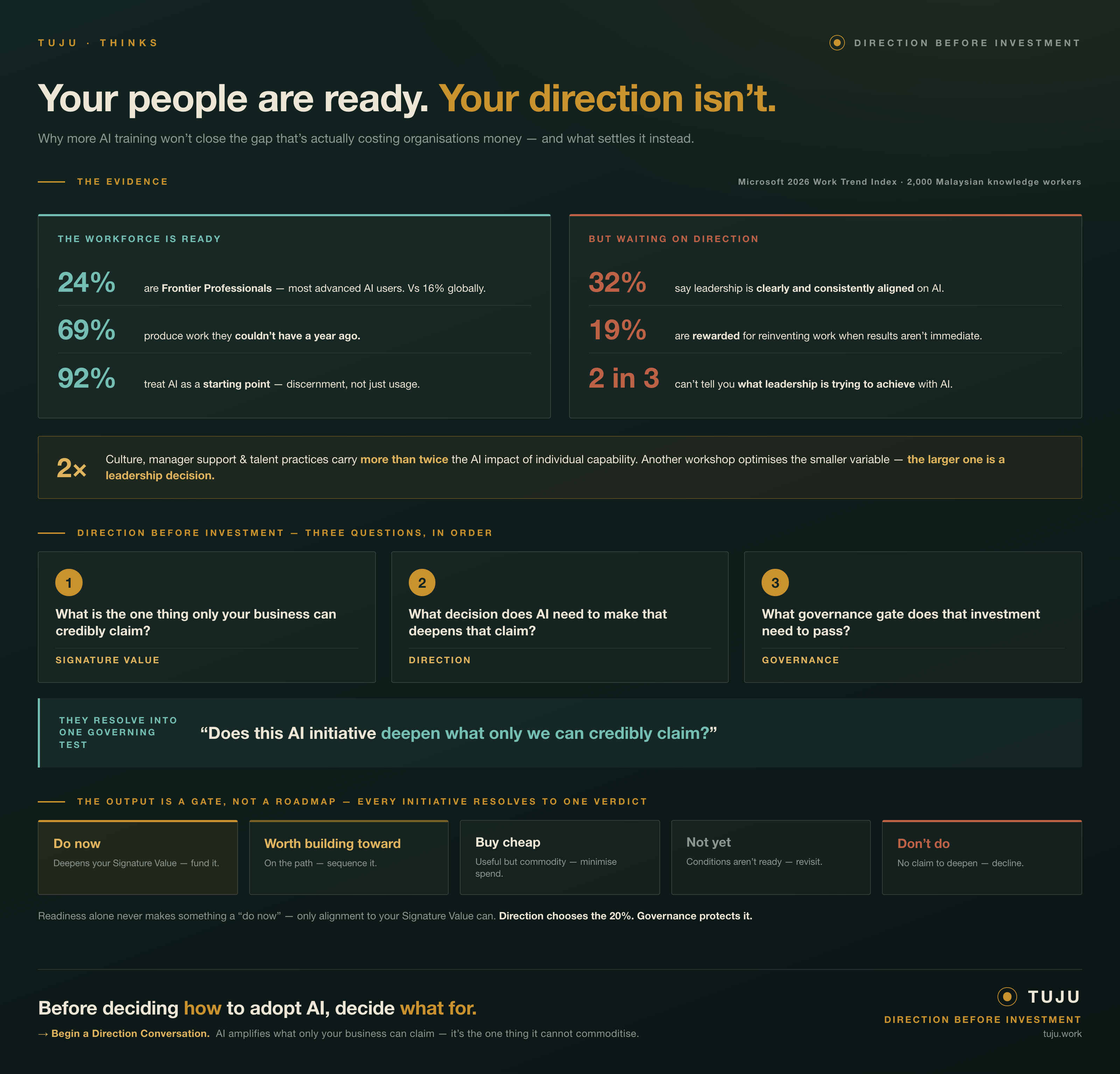
The evidence: your people are ready. Source: Microsoft 2026 Work Trend Index, 2,000 Malaysian knowledge workers.
The evidence
The workforce is not the constraint. Microsoft's 2026 Work Trend Index analysed trillions of anonymised productivity signals and surveyed 2,000 knowledge workers in Malaysia. The findings dismantle the assumption that capability is what's holding organisations back.
- 24% of Malaysian workers are Frontier Professionals — the most advanced AI users in the research, against 16% globally.
- 69% of Malaysian AI users say they are producing work they could not have produced a year ago.
- 92% treat AI output as a starting point rather than a final answer, and stay responsible for the thinking.
That last figure matters more than it appears. It describes discernment, not just usage — people who know when to rely on the tool and when not to. Malaysian workers are not behind on AI. On the measures that count, they are ahead of the global average.
Now the other side of the same study.
- 32% of Malaysian AI users say their leadership is clearly and consistently aligned on AI.
- 19% say they are rewarded for reinventing how work gets done when those efforts don't produce immediate results.
Microsoft calls this the Transformation Paradox: employees feel pressure to adopt AI quickly, while the systems around them — metrics, incentives, norms — continue to reinforce the old way of working.
Two in three employees using AI capably cannot tell you what their leadership is trying to achieve with it.
Where the leverage actually sits
Individual capability is the smaller variable. The same research found that culture, manager support, and talent practices account for more than twice the AI impact of individual mindset and usage.
That is the finding that should reset the training budget conversation. If organisational conditions carry twice the weight of individual capability, then another workshop is optimising the smaller variable — and the larger one is a leadership decision that no training programme can make on your behalf.
Globally, only 19% of organisations reach the Frontier category, where individual capability and organisational readiness are both high. The majority sit in an emergent state: adoption underway, conditions still forming.
The pattern holds outside Malaysia. Roughly 88% of organisations now use AI in at least one business function, yet only around a quarter have moved a meaningful share of experiments into production. Deployment is not the constraint. Direction is.
Why the gap persists
Everyone is working downstream. The advisory market is well-served — but almost entirely downstream of this decision. Readiness assessments measure infrastructure, governance maturity, talent, and compliance posture. Implementation partners execute against a strategy. Vendors optimise the stack.
Every one of these is valuable. Every one of them assumes the strategic direction has already been settled.
Very little in the market tests whether that direction is right in the first place — whether the organisation has a defensible answer to why this investment ahead of that one. That question sits above procurement, and it is not a technology question at all.
Direction before investment
This is where Tuju was built — not to deliver a strategy on an organisation's behalf, and not to teach tools, but to run the conversation that produces a decision, with the leadership who will have to live with it in the room.
The underlying thesis is straightforward: AI amplifies what an organisation already does, stands for, and delivers. It does not replace what makes it itself. AI commoditises surface execution — the same tools, the same speed, the same standard become available to every competitor. The one thing it cannot commoditise is the one thing only your business can credibly claim.
We call that the Signature Value. It is the only place AI compounds instead of levels.
Most AI programmes begin with discovery — auditing processes, mapping workflows, surveying tools. Useful work. But discovery without direction produces a long list of things that could be improved and no basis for deciding which should be.
Direction comes first. It is what turns a list of opportunities into a decision about capital, attention, and sequence.
Three questions, in order
- What is the one thing only your business can credibly claim? — Signature Value
- What decision does AI need to make that deepens that claim? — Direction
- What governance gate does that investment need to pass? — Governance
Answer these, and discovery has something to point at. Skip them, and discovery becomes an inventory — thorough, expensive, and directionless.
The three resolve into a single governing question, specific to the organisation, that every subsequent AI decision is tested against:
Does this AI initiative deepen what only we can credibly claim?
Governance then operates as an investment gate rather than a compliance checkbox — deciding what is worth funding, scaling, and trusting. Direction chooses the 20%. Governance protects it.
A gate, not a roadmap
The output is not a prioritisation matrix. Every initiative on the table resolves to one of five verdicts — do now, worth building toward, buy cheap, not yet, or don't do — with the reasoning attached to each.
That is a more decisive instrument than most strategy work produces, and deliberately so. Readiness alone can never make something a "do now"; only alignment to the Signature Value can. A well-resourced initiative that does not deepen what only you can claim is, at best, something to buy cheaply. It is not where capital or leadership attention should go.
It also makes principled refusal possible. When there is an agreed basis for saying no, saying no stops being a personal risk and becomes a defensible position — which is precisely what the 19% figure on rewarding reinvention suggests is missing.
Your people are already ahead. The Work Trend Index is clear on that, and it is the more encouraging half of the finding.
What they are waiting on is not another workshop. It is a direction clear enough that they know which problems are worth pointing AI at — and a leadership position defensible enough that reinventing how work gets done is rewarded rather than quietly penalised.
Before deciding how to adopt AI, decide what for.
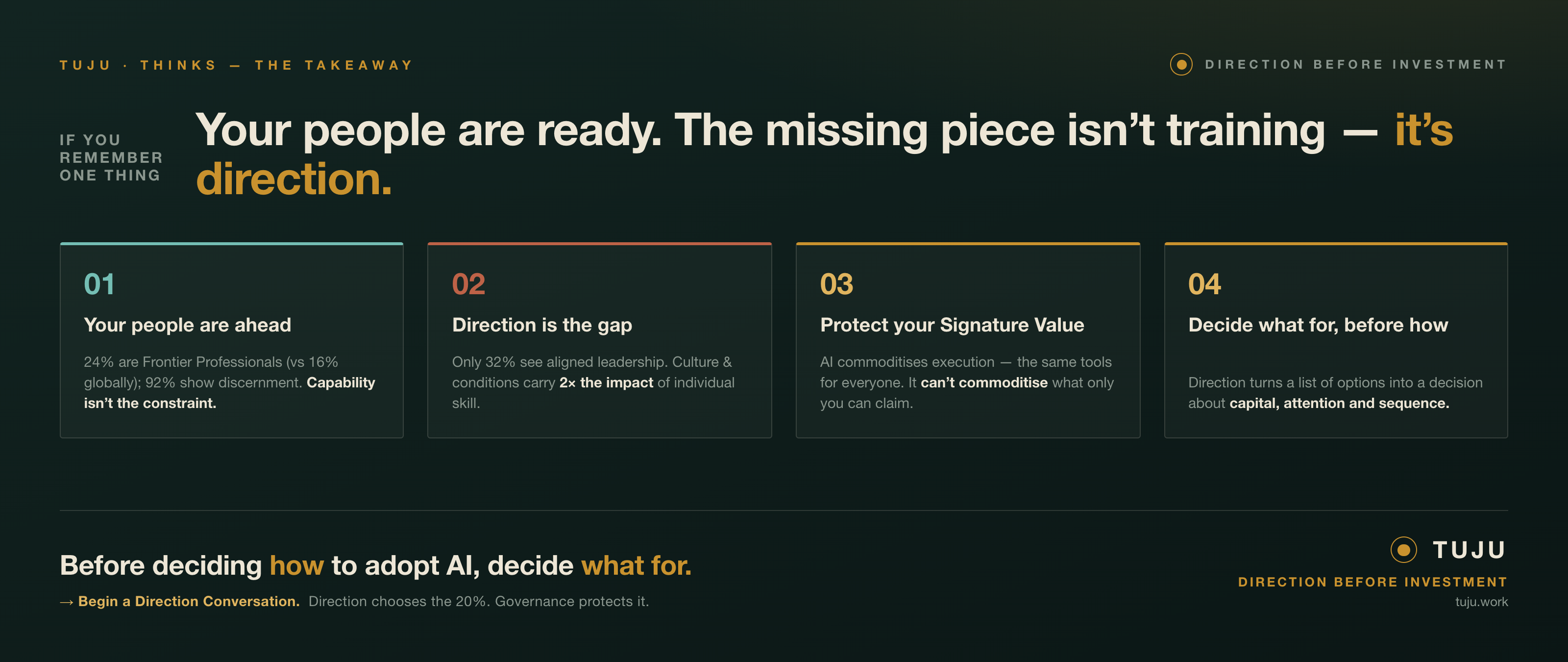
If you remember one thing: the missing piece isn't training — it's direction.
Sources
- Malaysian workforce and leadership-alignment figures: Microsoft 2026 Work Trend Index, Malaysia release, 23 June 2026 — based on trillions of anonymised productivity signals and a survey of 2,000 knowledge workers in Malaysia.
- Global enterprise AI adoption and production-deployment rates: McKinsey State of AI and Deloitte 2026 enterprise AI research.