A leader recently asked me: "I have an agriculture monitoring system — how do I expand it with AI?"
It is the right question. But most businesses ask it too early.
Before asking how to integrate AI, ask this first: what decision does AI need to make that it cannot make today? Without that clarity, AI becomes a feature added for its own sake — what many now describe as the AI value illusion: high activity, weak business impact.
Enterprise data shows the scale of the problem. In one 2026 benchmark, 67% of organizations reported more than 100 proposed AI use cases, yet 94% had fewer than 25 in production.
That is not a technology problem. It is a strategy problem.
Start with your signature
And it leads to a second question — the one that decides where capital should go: of all the decisions AI could improve, which ones deepen the one thing only your business can do?
That is your signature. It may be unique data, a distinctive operating model, or a capability competitors cannot easily copy. Models, vendors, and outputs can be bought by anyone. Your signature cannot.
Fund AI there, and it compounds your advantage. Fund it elsewhere, and you risk paying to look more like the market.
This is why the conversation in 2026 is shifting from experimentation to portfolio management. The question is no longer whether AI can do something interesting. The question is whether it can create durable value, at scale, inside your business. Deloitte's 2026 AI report says leaders are moving from ambition to activation, with ROI, safe and ethical practices, and workforce readiness now central to the discussion.
So where do you start? With two moves.
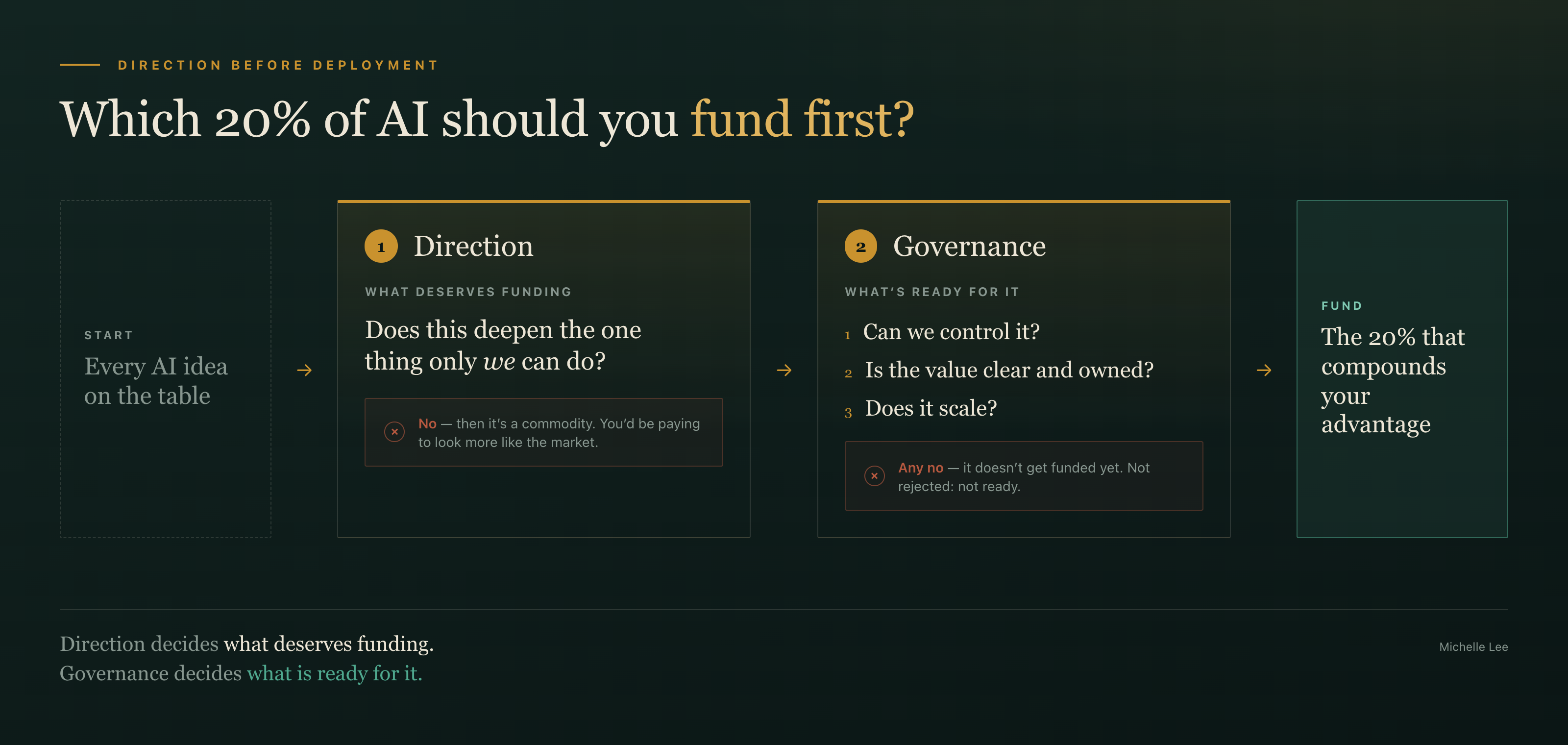
Direction decides what deserves funding. Governance decides what is ready for it.
First, direction. Fund the 20% of AI that deepens what only you can do. Everything else is a commodity unless it directly strengthens your edge.
Then, governance. Not as a compliance exercise, but as the investment gate that determines whether a use case can be trusted, measured, and scaled.
Three gates decide whether a use case gets funded
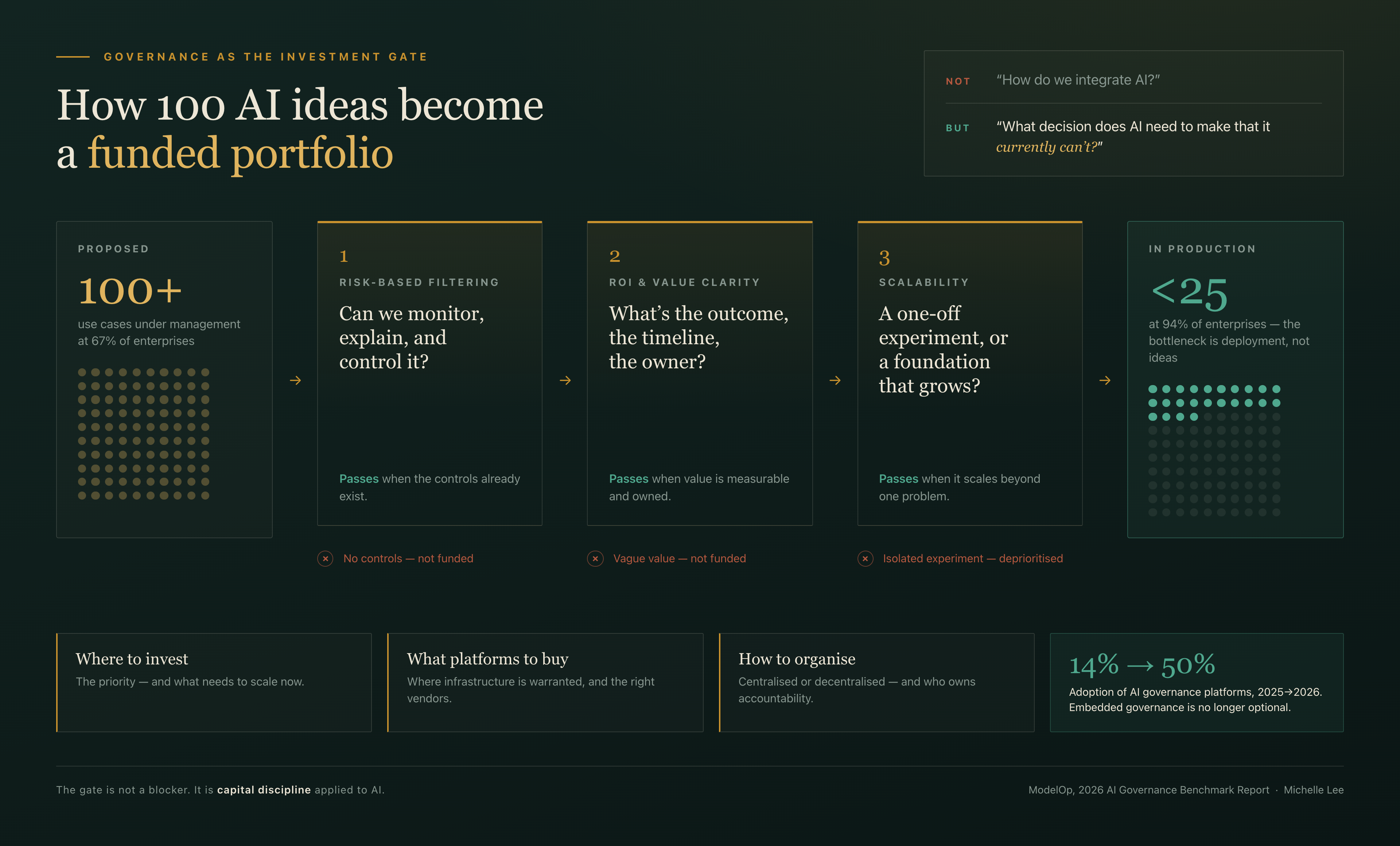
The gate is not a blocker. It is capital discipline applied to AI. Source: ModelOp, 2026 AI Governance Benchmark Report.
Gate 1 — Risk-based filtering. Can we monitor, explain, and control what this AI does? If not, it does not get funded until those controls exist.
Gate 2 — ROI and value clarity. What outcome are we expecting, on what timeline, and who owns the result? If the value case is vague, the investment is not ready.
Gate 3 — Scalability. Is this a one-off experiment, or a capability that can be reused across teams, sites, or markets? Capital should go to what can scale.
This is where governance stops being a blocker and becomes a decision tool. It helps leadership decide three things clearly:
- Where to invest first.
- What platforms to buy.
- How to organize ownership and accountability.
That shift is already visible. In ModelOp's 2026 AI Governance Benchmark, use of commercial AI lifecycle management and governance platforms rose from 14% in 2025 to nearly 50% in 2026 — governance is becoming operational infrastructure, not an afterthought.
Direction decides what deserves funding. Governance decides what is ready for it.
Sources
- ModelOp 2026 AI Governance Benchmark: 67% of enterprises report 101–250 proposed AI use cases, while 94% have fewer than 25 in production.
- Deloitte 2026 AI report: organizations are moving from experimentation to scaling, with governance and workforce readiness becoming central to enterprise AI value.