Read enough AI job descriptions and a pattern appears. The same role — Head of AI, Chief Transformation Officer, Chief Digital Officer — is asked to carry an unusually wide brief:
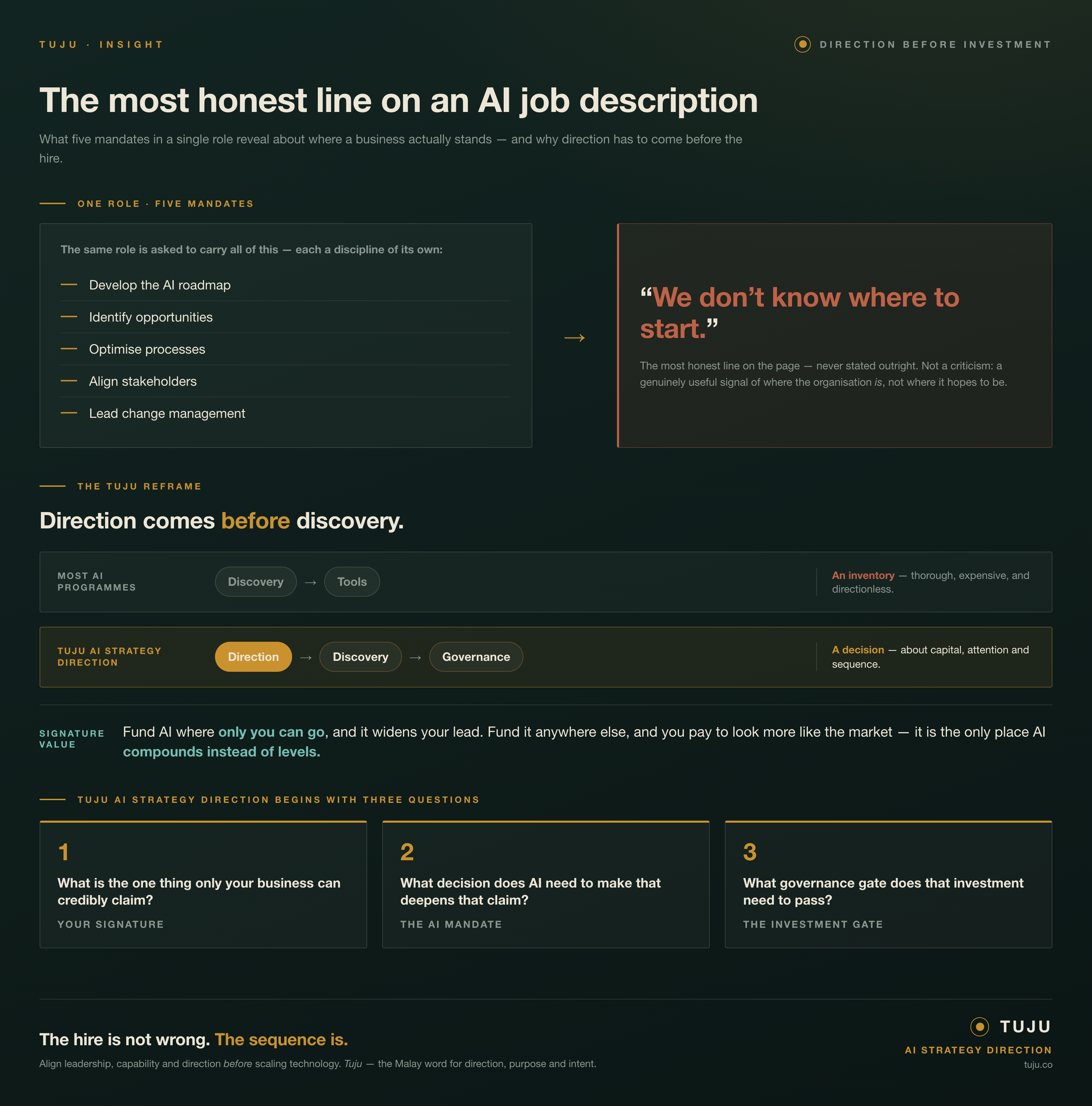
- Develop the AI roadmap
- Identify opportunities
- Optimise processes
- Align stakeholders
- Lead change management
Five mandates. One hire. Each of them a discipline in its own right.
None of these lines is dishonest. But together they say something the posting never states outright — and it is the most honest thing on the page:
We don't know where to start.
That is not a criticism. It is a genuinely useful signal, and worth reading carefully — because it tells you where the organisation actually is, not where it hopes to be.
The hire is not wrong. The sequence is.
What the hire is really saying
Intention without internal capability. A senior AI appointment signals that a business has recognised something important: that AI is not an application to install, but a structural undertaking. It requires roadmapping, process redesign, decision rights, change management, and an operating model capable of carrying it.
It also signals that no one inside the organisation can be pointed to and trusted to lead it. That may be entirely reasonable — the capability genuinely may not exist internally. But it means the company is hiring someone to answer a question it has not yet answered for itself.
And here is the difficulty: "where do we start" is not a question a new appointment can answer on arrival. It requires knowledge of the business that only the business holds — what it is trying to become, what its customers actually value, and where its advantage genuinely lives.
The readiness gap
Ambition is not the same as foundation. The wider a role's brief, the more it tends to reveal about what is still missing underneath it. And across Southeast Asia, the foundation is more uneven than the ambition suggests.
Cloud adoption sits at around 60%. Cybersecurity at 59%. Big data and analytics at 55%. Automation at 48%. IoT at 28%. These are not weak numbers in isolation — but they describe an uneven base on which AI is now being layered.
94% of ASEAN firms report having a digital transformation plan. Only 23% are considered genuinely transformative in their AI adoption — using it to reshape markets, customers, and business models rather than simply to run faster.
Interest and capability are not the same thing. AI does not fix a foundation. It inherits one.
The deeper implication
AI is a business model question before it is a technology one. Companies that extract compounding value from AI tend to redesign workflows, decision rights, and coordination before they select tools — not after. Because AI reshapes several dimensions at once: how value is created through products, services, pricing and experience; how decisions get made and by whom; and where structural advantage sits.
Which means AI is rarely about doing the same work faster. It is about deciding whether the business itself should work differently — and if so, toward what.
The harder question
When everyone has the same tools, what remains? Marketing has long relied on a unique selling proposition to separate one business from another — to make it more desirable, more chosen, more remembered.
Now consider what AI does to that logic. If AI lets every competitor deliver the same service, at the same speed, to the same standard — what is left to be different?
Fund AI where only you can go, and it widens your lead. Fund it anywhere else, and you have paid to look more like the market.
Differentiation does not disappear in an AI-driven market. It moves. It shifts away from surface-level execution — which becomes copyable — and toward what is harder to replicate: data quality, operating discipline, customer understanding, and above all the one thing only your business can credibly claim. The capability, the insight, the way of delivering that is genuinely yours.
We call that your Signature Value. It is the only place AI compounds instead of levels.
Tuju · AI Strategy Direction
Direction comes before discovery. Most AI programmes begin with discovery — auditing processes, mapping workflows, surveying tools. Useful work. But discovery without direction produces a long list of things that could be improved, and no basis for deciding which ones should be.
Direction comes first. It is what turns a list of opportunities into a decision about capital, attention, and sequence.
Tuju — the Malay word for direction, purpose and intent — names what most AI efforts are actually missing. Not technology. Not talent. A clear articulation of what the business stands for, what it is trying to become, and where AI can deepen that rather than dilute it.
Tuju AI Strategy Direction begins with three questions:
- What is the one thing only your business can credibly claim?
- What decision does AI need to make that deepens that claim?
- What governance gate does that investment need to pass?
Answer these, and discovery has something to point at. Skip them, and discovery becomes an inventory — thorough, expensive, and directionless.
Reading the signal
The hire is not wrong. The sequence is. A company hiring AI and transformation leaders is telling the market it wants to modernise. That instinct is sound. The question is whether it knows what it is modernising toward.
If digital transformation has not yet matured, one senior appointment will not close the gap. Success comes from aligning leadership, capability and direction before scaling technology — and from being honest about which of those is actually missing.
Because the question was never which AI tools to adopt. It is what you stand for in a market where everyone has access to the same tools — and how you use AI to make that more true, not less.
That is a strategy conversation. And it belongs before the job posting, not after it.
Sources
- ASEAN digital adoption and transformation-plan figures — regional industry survey data.
- 23% transformative AI adoption — SAS Institute, Southeast Asia AI adoption study.
- Enterprise AI trends — Deloitte AI Institute, Enterprise AI Trends 2026.