In business, there is never a 100% answer. Every great business leader makes decisions with incomplete information — the question is never whether to act without full certainty, but how much is enough to act well.
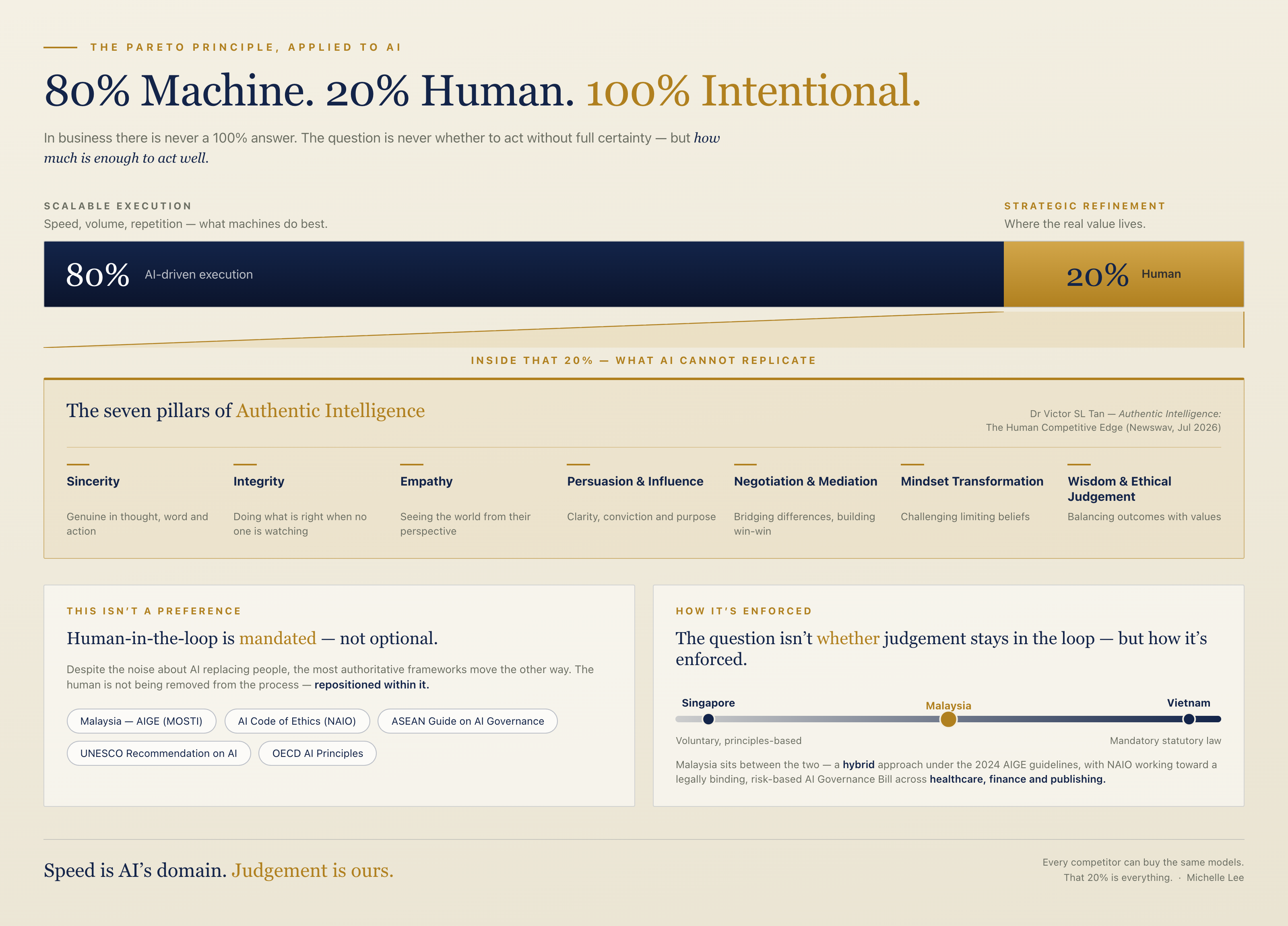
The Pareto Principle offers a useful lens here. 80% of outcomes come from 20% of causes — focus on the highest-impact inputs and the returns compound. Applied to AI, the same logic holds: 80% AI-driven, scalable execution. 20% human strategic refinement. Not because AI can't do more — but because that 20% is where the real value lives.
Speed is AI's domain. Judgement is ours.
The frameworks agree
Despite the noise around AI replacing human roles, the most authoritative national and regional AI governance frameworks are moving in the opposite direction — embedding human-in-the-loop (HITL) and human-centric principles as non-negotiable requirements, not optional considerations.
Malaysia's AIGE framework (MOSTI) and AI Code of Ethics (NAIO), the ASEAN Guide on AI Governance and Ethics, UNESCO's Recommendation on AI, and the OECD AI Principles all share this mandate. The human is not being removed from the process. The human is being repositioned within it.
What's instructive is how different countries are approaching enforcement. Singapore takes a voluntary, principles-based route. Vietnam has enacted mandatory statutory law with legal arbitration established. Malaysia sits between the two — currently operating under a hybrid approach through its 2024 national AIGE guidelines, while NAIO works toward a legally binding, risk-based AI Governance Bill that, once passed, would apply across healthcare, finance, and publishing services.
The direction is clear: the question is not whether human judgement will remain in the loop, but how it will be structured and enforced.
What human judgement actually means
In his article Authentic Intelligence: The Human Competitive Edge in the Age of Artificial Intelligence (Newswav, July 2026), Dr Victor SL Tan — author of 21 books, with work published in NST, The Star, and Smartinvestor — identifies seven pillars that define what humans bring that AI cannot replicate:
- Sincerity — being genuine in thoughts, words and actions
- Integrity — doing what is right, even when no one is watching
- Empathy — understanding people deeply and seeing the world from their perspective
- Persuasion & Influence — inspiring hearts and minds with clarity, conviction and purpose
- Negotiation & Mediation — building win-win solutions and bridging differences
- Mindset Transformation — challenging limiting beliefs and inspiring possibilities
- Wisdom & Ethical Judgement — making decisions that balance outcomes with values
These are not soft skills. They are the reasoning layer behind every consequential business decision — the things that determine how a process is designed, why a workflow is sequenced a certain way, and what an AI agent is ultimately trained to reinforce.
Speed is AI's domain. Judgement is ours.
And in a world where every competitor can access the same AI platforms, the same models, and the same automation tools — the organisation that wins won't be the one with the best AI. It will be the one that brought the best human thinking to building it.
That 20% is everything.
What does your 20% look like in your business — and are you protecting it?
Sources
- Dr Victor SL Tan, Authentic Intelligence: The Human Competitive Edge in the Age of Artificial Intelligence — Newswav, July 2026.
- Malaysia: AI Governance and Ethics (AIGE) framework, MOSTI; AI Code of Ethics, NAIO. Regional and international: ASEAN Guide on AI Governance and Ethics, UNESCO Recommendation on the Ethics of AI, OECD AI Principles.